Quick answer
Electricals should never go in the general bin. Small items go free to a recycling centre or a shop take-back point; working kit is worth donating; and a private collection handles broken TVs, bulky electricals or a full clear-out in Southampton.
What counts as e-wasteSection titled What%20counts%20as%20e-waste
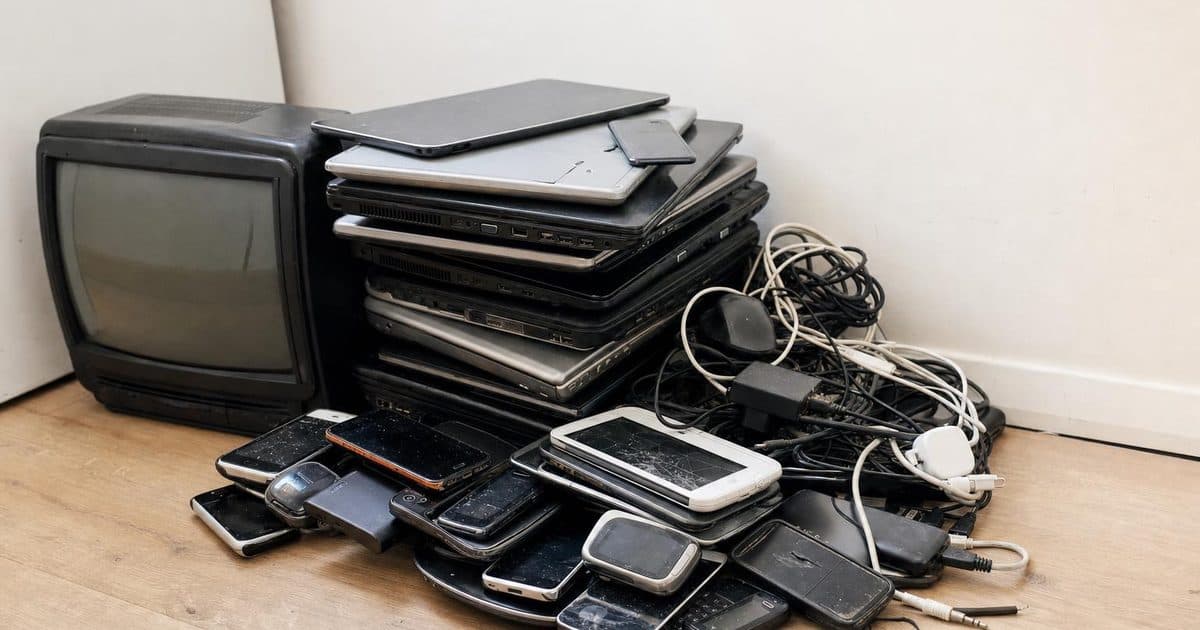
E-waste, or WEEE (waste electrical and electronic equipment), is the official term for anything that runs on a plug, battery or cable and has reached the end of its life. It covers far more than obvious gadgets - if it has a lead or a cell inside, it counts.
- Phones, tablets and other handheld devices
- Computers, laptops and printers
- TVs and monitors
- Small appliances - kettles, toasters, hairdryers, vacuum cleaners
- Cables, chargers and leads
- Batteries, from single cells to power tool packs
1.45 million
tonnes of e-waste a year
Material Focus / Lancaster University research
1 in 3
UK adults recycled an old electrical last year
Material Focus, 2024
880 million
unused electrical items sitting in UK homes
Material Focus, 2024 (around 30 per household)
Why it should never go in the binSection titled Why%20it%20should%20never%20go%20in%20the%20bin
Electricals contain materials that don't belong in a landfill lorry - trace amounts of lead and mercury, plus lithium batteries that can spark fires when crushed by bin wagons or sorting equipment. Councils and waste companies report growing numbers of vehicle and depot fires traced back to batteries thrown in with ordinary rubbish, which is one of the main reasons WEEE has to be kept separate.
There's also a practical cost to binning it: old electricals contain recoverable copper, steel, precious metals and plastics that can be reused in new products when they're processed correctly. Put them in general waste and all of that is lost. It only takes a short detour to a recycling centre or take-back point to recover it instead.
Recycling centres serving SouthamptonSection titled Recycling%20centres%20serving%20Southampton
Southampton's Household Waste Recycling Centre (HWRC) is run by Southampton City Council at City Depot & Recycling Park, First Avenue, Southampton, SO15 0LJ. It takes electrical items and fluorescent tubes free of charge, along with fridges and freezers (which should be brought whole, with no parts removed) and batteries.
A booking is required before every visit - same-day slots are usually available, and you book online through the Southampton HWRC page. Residents don't need a permit or proof of address to book, though larger vehicles and trailers over 3 metres do need one arranged in advance. Opening hours vary through the year (currently 9am-6pm in summer, 9am-4pm in winter), with a daily closure from 12:30-1pm and closures on Christmas Day, Boxing Day and New Year's Day - check current hours before you set off.
Shop and retailer take-back schemesSection titled Shop%20and%20retailer%20take-back%20schemes
Under the UK's Retailer Take-back Scheme, any shop that sells you a new electrical item has to take your old one back free of charge - you have 28 days from your purchase and just need the receipt, and the old item doesn't have to be the same brand. Larger retailers such as Currys, B&Q, Waitrose and John Lewis go further and accept small electricals in-store at any time, even without a new purchase.
Smaller independent shops can instead join the Distributor Take-back Scheme (DTS), which lets them fund household recycling centres rather than take items back in person - so it's always worth asking in-store what a particular shop offers. Most supermarkets also run dedicated battery collection points near the entrance, which is a handy drop-off for old batteries on a normal shopping trip.
What Southampton Council will collectSection titled What%20Southampton%20Council%20will%20collect
Southampton City Council does not currently collect electricals or batteries in the kerbside recycling bin - its guidance is clear that they should always be recycled separately, via the HWRC, a retailer take-back point or a supermarket battery bin.
Larger items, including TVs, are covered by the council's bulky waste collection service instead. Collections are booked and paid for online, with a minimum charge of £23 per visit and up to 10 items per booking (residents on qualifying benefits get a 25% discount). Pricing depends on size: a TV up to 49 inches is charged as a large item (£26), a 50-inch-plus TV or an American-style fridge-freezer as extra-large (£40), and smaller electricals such as microwaves or computers as standard items (£15) - see the bulky waste price list for the full breakdown. Prices and terms are set by the council and can change, so check the current page before booking.
Wipe it, then donate or reuseSection titled Wipe%20it%2C%20then%20donate%20or%20reuse
Clear your data firstSection titled Clear%20your%20data%20first
Before anything leaves the house, sign out of accounts and remove SIM and memory cards, then run a full factory reset on phones, tablets and laptops so no personal data or saved passwords remain. For old hard drives holding sensitive files, a secure-erase tool or physical destruction gives extra peace of mind if a factory reset alone doesn't feel like enough.
Where to donate working electronicsSection titled Where%20to%20donate%20working%20electronics
If it still works, it's worth more donated than recycled. British Heart Foundation has two Southampton shops that take electrical donations - the Above Bar Street store and the West Quay Retail Park furniture and electrical store - and also offers a free home collection service for larger items, bookable online by postcode.
Most other local charity shops will take smaller working electricals such as kettles, lamps and toasters over the counter, though it's always worth phoning ahead to check what a particular branch can accept that day.
When a private collection makes senseSection titled When%20a%20private%20collection%20makes%20sense
A recycling centre trip makes sense for a bag of cables or a single old kettle, but it stops being practical once you're dealing with a house clearance full of mixed electricals, an office clear-out of old monitors and printers, or a broken TV too heavy or awkward to load into a car. In those cases, Southampton House Clearance collects e-waste alongside general clearance loads as part of the same visit, with everything taken to a licensed waste carrier for responsible disposal.
Your main routes side by side
Recycling centre or take-back
Best for: A few portable items and you have transport.
- Cost
- Free
- Timing
- Booking required for the HWRC
- Southampton HWRC on First Avenue, or a retailer take-back point
- Free for household electricals
- You do the sorting and transport
Collection with Southampton House Clearance
Best for: Bulky electricals, mixed loads or whole-property clear-outs in Southampton.
- Cost
- Priced by load and access
- Timing
- Same-day and next-day slots available
- TVs, appliances and mixed e-waste in one visit
- Collected from inside the property
- Licensed disposal with reuse and recycling first
Got more than a boot-load?
We collect e-waste, appliances and mixed clearance loads across Southampton — carried out, recycled responsibly.
Which option fits your situationSection titled Which%20option%20fits%20your%20situation
Match your situation
A drawer of cables, chargers and small gadgets
Recycling centre or shop binDrop them at the HWRC or a retailer take-back point next time you're passing.
It still works
Donate or sellWorking electronics are worth more reused than recycled.
A single TV or large appliance, no other waste to clear
Southampton CouncilBook a bulky waste collection online for a fixed per-item charge.
A broken TV, several appliances or a full clear-out
Private collectionOne visit, carried from inside, disposed of with a licensed carrier.
Related servicesSection titled Related%20services
Want it gone without the lifting?
Tell us what needs to go and we will give you a free, no-obligation quote for Southampton and nearby areas.